
A Hammersmith and Fulham resident wants the government to fund a national Clare's Law campaign. Her petition needs 10,000 names and closes 4 March 2027.
A Hammersmith and Fulham resident has started a parliamentary petition asking the government to fund a national awareness campaign for Clare’s Law, the scheme that lets people ask the police whether a partner has a record of abuse.
Ellie Budden-McCarthy is named as the creator of petition 778630, which was published on 4 September and stays open until 4 March 2027. It had 68 signatures when we checked on Monday 8 September. Four came from the Chelsea and Fulham constituency and one from Hammersmith and Chiswick.
The thresholds are fixed. At 10,000 signatures the government has to respond in writing. At 100,000 the petition is considered for a debate in Parliament.
She emailed Fulham Wire asking us to tell readers about it, and we are reporting it as a local campaign rather than reprinting her appeal.
What the petition asks for
The wording on the petition page is short:
I call on the Government to fund a national awareness campaign for Clare’s Law, including working with police forces and public services to promote the scheme so people know that they can request a disclosure if they are considering starting a relationship.
The supporting section explains where the idea came from, in her own words:
This petition is informed by my own experience. I became aware of Clare’s Law only after circumstances had escalated to the point that police involvement was necessary. Had I known that the scheme existed and how accessible it was, I would have sought a disclosure much sooner.
I believe awareness should not depend on someone already knowing what to search for. Greater public awareness could help people make informed decisions before they are at risk.
Writing to us, she put her own experience as the starting point rather than the argument:
My initial motivation to creating this petition has come from my own experience but my primary motivation is my serious concern for the rest of the nation. There will be countless numbers of people who will have suffered, will continue to suffer and who are yet to suffer as a result of the failings caused by the lack of campaigning and visibility surrounding Clare’s law which can only be remedied by the governments attention.
That last point is her assessment, not a finding by anyone else. She asked us to consider “helping me to spread the word on this petition and the importance of others doing so in order for it to be successful”.
What Clare’s Law actually is
The scheme’s formal name is the Domestic Violence Disclosure Scheme. The council sets out how it works on its own Violence Against Women and Girls page, and it has two halves:
- Right to ask. You, or a relevant third party such as a family member, can ask the police to check whether a current or former partner has a violent or abusive past.
- Right to know. The police can make a disclosure on their own initiative if information reaches them that affects someone’s safety.
A disclosure is not automatic. The council’s page says it has to be lawful, reasonable and proportionate, based on a credible risk of violence or harm, and compliant with data protection and human rights law. The scheme started across all forces in England and Wales in March 2014.
The government’s domestic abuse guidance adds the practical part. A request can be made in person at a police station or elsewhere, by telephone, by email, online, or as part of a police investigation. You can also apply on behalf of someone you know.
In London the application route is the Met’s own form for requesting information under Clare’s Law, which is the link the council itself points residents to.
How often it is used in London
The Met released annual figures under freedom of information in February 2024, covering 12 March 2014 to 31 December 2023 (reference 01/FOI/24/034999).
Right to ask requests went from 90 in the first partial year to 2,890 in 2023. Right to know disclosures rose from 53 to 1,032 over the same period, peaking at 1,564 in 2021. The combined total was 3,899 in 2023, against 142 in 2014.
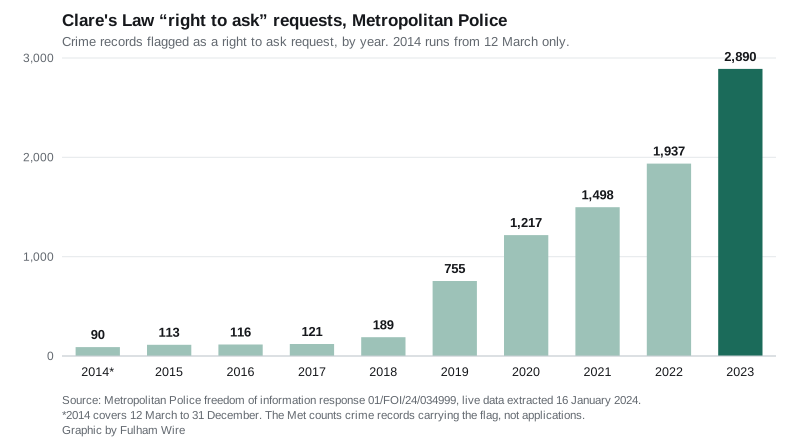
Read those numbers carefully, because the Met is careful about them. Its notes say the table is a distinct count of crime records carrying a Clare’s Law flag, not a count of applications, and that a flag removed and added again in a different year will appear twice. The force also warns the yearly figures may not add to the grand total for that reason.
What the figures do show is a scheme in growing use across a force area of roughly nine million people. Whether that counts as enough is the question the petition puts to the Home Office, which is the department listed against it.
What it means for you
- To make a request in Hammersmith and Fulham, use the Met’s Clare’s Law form. You do not have to be the person at risk to apply.
- To sign the petition, you need to be a British citizen or UK resident, and you sign at petition.parliament.uk/petitions/778630. It closes on 4 March 2027.
- For local support, the council commissions the Angelou Partnership to run the borough’s violence against women and girls services. Its numbers are 0808 801 0660, Monday to Friday 10am to 4pm and Wednesdays 6pm to 9pm, and 0800 059 0108, Monday to Friday 10am to 6pm and Thursdays 8am to 9pm. Translators are available.
- Outside those hours, the National Domestic Abuse Helpline is open 24 hours a day on 0808 2000 247.
- The Hammersmith and Fulham police Community Safety Unit, which investigates domestic abuse in the borough, is on 020 8246 2828. In immediate danger, call 999.
Fulham Wire has not reported the personal circumstances behind the petition and has not sought to. Everything set out above is on the public record: the petition wording, the signature count, the council’s own guidance and the Met’s disclosure figures, each linked in the text.
Have your say