
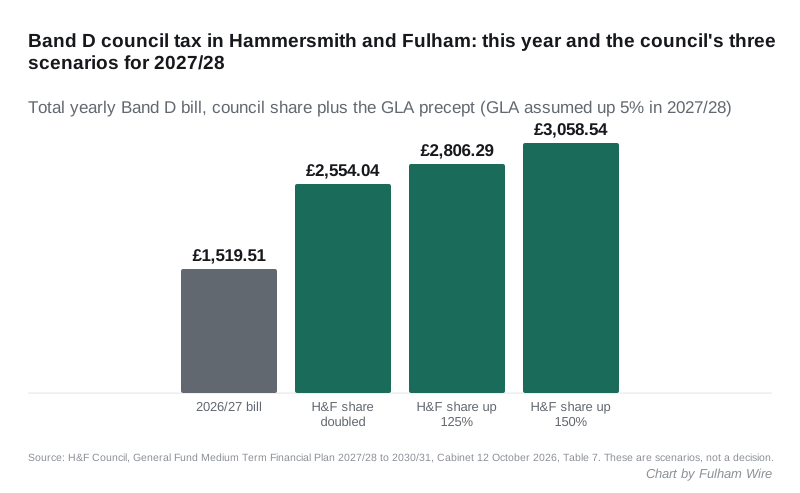
The council's own scenarios raise its share of the bill by 100% to 150% from April 2027, a Band D total of up to £3,059. Residents get a say from 19 October.
Hammersmith and Fulham Council has put figures on the council tax rise it says it cannot avoid. Its own scenarios would double its share of the bill from April 2027, or raise it by as much as 150 per cent.
On the highest of the three, a Band D home would pay £3,058.54 in 2027/28. That is £1,539.03 more than this year’s £1,519.51, or about £29.60 a week.
The figures are in the council’s medium term financial plan, which Cabinet noted on Monday 12 October. They are scenarios, not a decision. The council says it will ask residents for their views between 19 October and 15 November, before the budget is set in March.
The three scenarios
The report models three rises in the council’s own part of the bill. In each, the Greater London Authority’s part goes up by an assumed 5 per cent, to £536.04.
| Scenario for 2027/28 | Council share (Band D) | Total Band D bill | Rise on this year | Rise per week |
|---|---|---|---|---|
| This year, 2026/27 | £1,009.00 | £1,519.51 | ||
| Council share doubled | £2,018.00 | £2,554.04 | £1,034.53 | £19.89 |
| Council share up 125% | £2,270.25 | £2,806.29 | £1,286.78 | £24.75 |
| Council share up 150% | £2,522.50 | £3,058.54 | £1,539.03 | £29.60 |
The weekly figures are the council’s own, from Table 8 of the report. On the total bill, the three scenarios are rises of about 68, 85 and 101 per cent.
Other bands pay a fixed fraction of Band D, so every household’s bill would move by the same percentage. Our Fulham council tax bands page has this year’s figure for each band.
Only the biggest rise balances the books
The report says the council faces a budget gap of £75 million in 2027/28, growing to £160 million by 2030/31. That gap is worked out before any council tax rise.
Each scenario assumes 5 per cent rises in the three years after 2027/28. On that basis the report says:
- doubling the council’s share raises £113.2 million by 2030/31, leaving a £46.1 million shortfall
- a 125 per cent rise raises £138.7 million, leaving £20.6 million
- a 150 per cent rise raises £163.9 million, which “broadly balances the budget on current assumptions”
The report is blunt about the choice. “Given the scale of the budget gap, it is unrealistic to think that it would be possible to set balanced budgets without doing so,” it says, meaning rises well above the usual limit.
Why the gap is so big
Most of it comes from the Government’s new “Fair Funding” formula. The report says the council received £150.5 million in Government funding in 2025/26. By 2029/30 that falls to £72.4 million, a cut of £78.1 million or 52 per cent.
The formula assumes each council charges close to the national average council tax. The report says it treats Hammersmith and Fulham as able to raise £170 million from council tax this year. The council actually collects £92.6 million.
Rising costs add to the gap. The report lists:
- an extra £19.8 million for adult social care in 2027/28
- £5 million more for temporary accommodation
- £2.4 million more for children’s services
- higher pay and price inflation
The forecast has worsened since February, when the gap to 2030/31 was put at £101 million.
What the council is doing first
The council is already over budget this year. The report forecasts a £14 million overspend in 2026/27, mostly in adult social care, temporary accommodation and children’s services. We reported an earlier forecast of £14.4 million.
It expects to hold about £66 million in uncommitted reserves at the start of 2027/28. The report warns that reserves “are not a route to balancing an annual revenue budget”.
It also points to £156 million saved since 2014 under its “Ruthless Financial Efficiency” programme, and says a full savings programme will come with the budget. It adds that savings “will not be enough to significantly close the budget gap in future years”.
Why there is no referendum
Councils normally need a local referendum to raise council tax by more than about 5 per cent. The Government has lifted that limit for 2027/28 and 2028/29 for six councils, including this one, Kensington and Chelsea, Wandsworth and Westminster. We explained the change in our earlier report.
The report says the Government “expects significantly above normal council tax increases” from these councils, and has assumed them in its own spending figures.
What happens next
- By 3pm on Friday 16 October: the Cabinet decisions can be called in, according to the decision list
- 19 October to 15 November: the main period of resident engagement. The council is commissioning an outside market research agency to run an independent survey. It will also take views online, in the community and in writing.
- After 15 November: the findings are published and go to budget scrutiny sessions
- 18 January 2027: Cabinet decides the council tax support scheme for low-income households
- Early March 2027: Full Council sets the 2027/28 budget and council tax
What it means for you
- This year’s bill does not change. Any rise applies to bills from April 2027.
- No rise has been agreed. The three figures are the council’s models. The level is set in March.
- Plan for a bigger bill. On the council’s own figures, a Band D home would pay between about £20 and £30 a week more.
- Give your view from 19 October. The engagement asks which services matter most and how the council should use the new freedom on council tax. We will add the survey link when it opens.
- If money is tight, watch the January support scheme decision. It sets how much help low-income households get with the bill.
- Check your band with the Valuation Office Agency. A wrong band would cost more as bills rise.
Sources
- H&F Council, General Fund Medium Term Financial Plan 2027/28 to 2030/31, report to Cabinet, 12 October 2026: the scenarios (Tables 7 to 9, paragraphs 5.1 to 5.7), the budget gap (Tables 4 and 5), the funding figures (Table 2 and paragraph 1.9), the overspend (paragraphs 2.1 to 2.5), reserves (paragraph 7.2) and the engagement dates (paragraph 6.4).
- H&F Council, Cabinet decision list, 12 October 2026, published 13 October, for the decision and the call-in deadline.
- H&F Council, Cabinet meeting page, 12 October 2026.
- H&F Council, key decisions list for the council tax support scheme date.
Have your say